


Govern, document, and automate every corporate process.
RapidBPM brings organizational structure, business processes, roles and responsibilities, delegation of authority, operational planning, corporate documentation, and policy management together on one governed platform — so the way your enterprise is supposed to run and the way it actually runs are finally the same thing.

Governance that runs, not governance that gathers dust.
Your org chart, RACI matrix, delegation-of-authority table, policies and processes usually live in disconnected files that nobody trusts by audit time. RapidBPM makes governance executable — structure, roles, authorities, policies and processes modelled once, linked, and enforced at the moment a decision is made.
Organizational Structure & Role Management
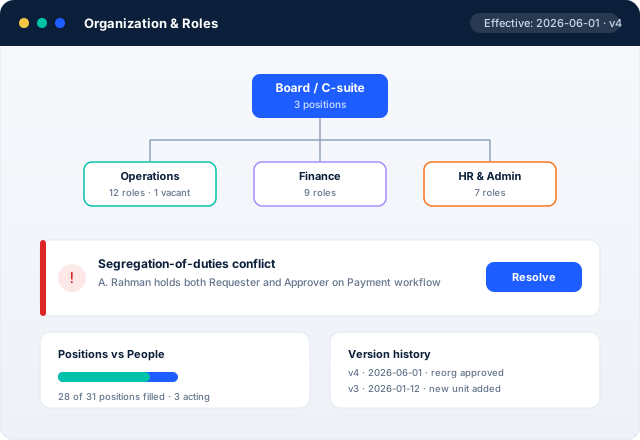
RapidBPM models your organization as a living, versioned hierarchy rather than a static chart. Entities, divisions, departments, units, and positions are first-class objects, each with its own attributes, cost centre, reporting line, and effective dates. When the structure changes — a merger, a reorganization, a new business unit — you version the change with an effective date, and everything downstream (authorities, approvals, policy ownership) re-resolves automatically against the new structure.
- ✓Versioned org hierarchy
- ✓Positions vs. people
- ✓Segregation of duties
- ✓Org-chart visualisation
- ✓Multi-entity ready
- ✓Competency & mandate mapping
Business Process Management
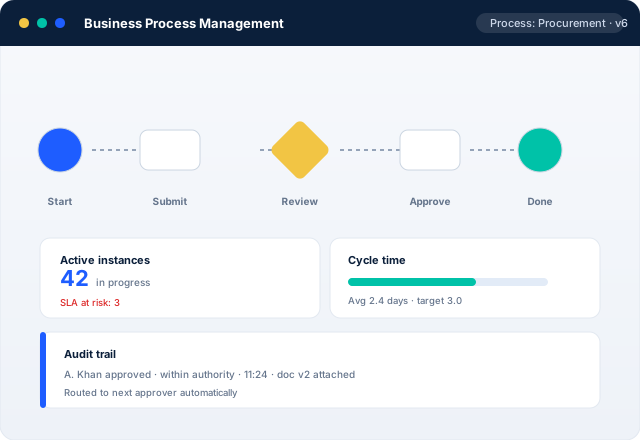
At the heart of RapidBPM is a full BPM engine: model your processes visually using BPMN-style notation, attach forms, rules, SLAs, and escalations, and run them as live, auditable workflows. Every process is tied back to the organizational structure, so steps route to roles and positions — never hard-coded to individuals — and re-route automatically when the structure or the delegation rules change.
- ✓Visual process modelling
- ✓Role-based routing
- ✓Versioned & governed processes
- ✓SLAs, escalations & reminders
- ✓Live process analytics
- ✓Full audit trail
Corporate Roles & Responsibilities Management
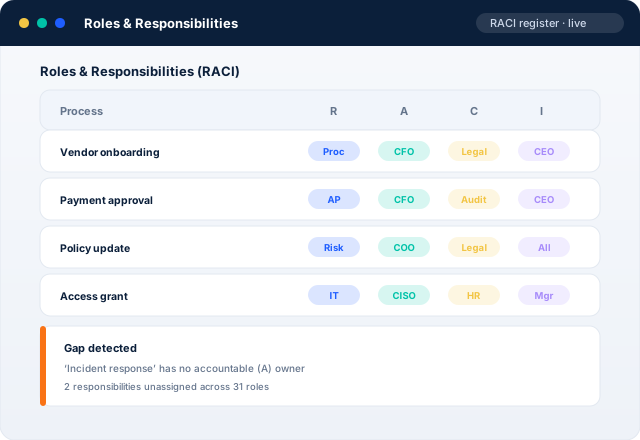
RapidBPM turns the RACI matrix from a spreadsheet nobody trusts into a governed, living register. Every responsibility, accountability, and decision right is mapped to a role and, through the role, to the position and the people who hold it. Because responsibilities are linked to processes and policies, you can answer the questions auditors and regulators actually ask: who is accountable for this control, who can approve this transaction, and where is that authority written down.
- ✓Governed RACI register
- ✓Role charters & profiles
- ✓Gap & overlap detection
- ✓Time-bound assignments
- ✓Responsibility-to-control linkage
- ✓On-demand reporting
Delegation of Authority (DoA) Management
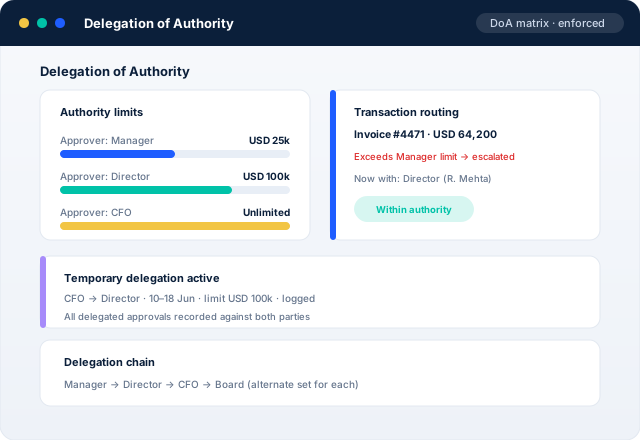
The Delegation of Authority module turns your DoA matrix into an enforced control rather than a reference document. Authority limits — financial thresholds, contract values, HR decisions, procurement bands — are defined against roles and positions, and the BPM engine consults them automatically at every approval step. If a transaction exceeds the approver's limit, it routes upward; if an approver is on leave, it follows the delegation chain to the designated alternate.
- ✓Authority matrix as a control
- ✓Automatic threshold routing
- ✓Temporary & conditional delegation
- ✓Delegation chains & alternates
- ✓Dual accountability logging
- ✓DoA reporting & attestation
Operational Plan
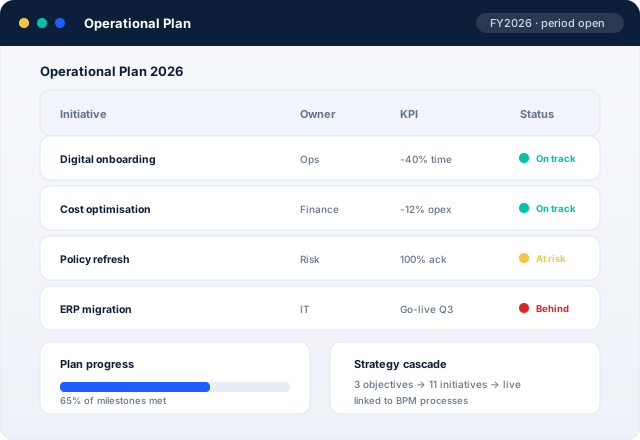
RapidBPM connects strategy to execution through a structured operational planning module. Strategic objectives cascade into departmental and unit-level operational plans, each broken down into initiatives, KPIs, milestones, owners, and budgets — all anchored to the same organizational structure and roles that run the day-to-day processes. Because plans, owners, and processes share one model, progress is not self-reported in a separate tool; it is observed from the work itself.
- ✓Strategy-to-execution cascade
- ✓KPIs, milestones & budgets
- ✓RAG status & variance
- ✓Roll-up dashboards
- ✓Linked to live processes
- ✓Period locking & history
Corporate Documentation Management
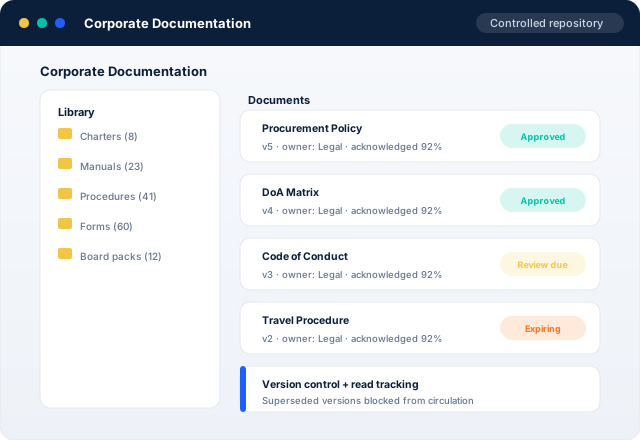
Governance only holds up if the documents behind it are controlled. RapidBPM provides a controlled document repository purpose-built for corporate and regulatory documentation — charters, manuals, procedures, forms, delegations, and board materials — with full version control, controlled distribution, and review/expiry lifecycles. Documents are linked to the structure, roles, processes, and policies they relate to, so you can navigate from a process step straight to the procedure that governs it.
- ✓Controlled repository
- ✓Review & expiry lifecycles
- ✓Approval workflows
- ✓Linked context
- ✓Access control & watermarking
- ✓Read tracking & search
Policy Management
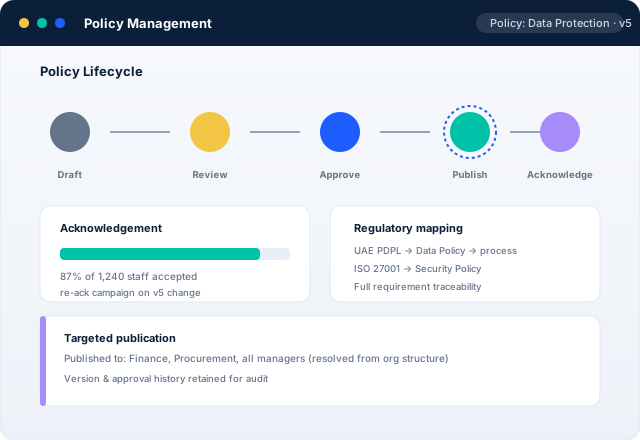
The Policy Management module governs the full lifecycle of corporate policies — from drafting and review through approval, publication, employee acknowledgement, and periodic re-review. Each policy is owned by a role, linked to the processes and controls it governs, and mapped to the regulations or standards it satisfies, giving you a clean line from a regulatory requirement to the policy that addresses it to the process that enforces it.
- ✓Full policy lifecycle
- ✓Role ownership & mapping
- ✓Targeted publication
- ✓Acknowledgement campaigns
- ✓Regulatory traceability
- ✓Version & approval history
Built for the audit, not the demo.
Cloud-native or sovereign
Container-first and multi-region. Deploy on AWS, Azure, GCP, OCI, your own data centre, or a sovereign-cloud region.
Open and composable
API-first with REST, GraphQL, webhooks, and SDKs. Integrates with your IdP, HRIS, ERP, and document stores.
Governed by default
RBAC, SoD, immutable audit logs, lineage, and policy-as-code — the controls auditors expect, switched on from day one.
Outcomes you can hold us to — by horizon.
Foundations
Model the org structure, load the DoA matrix, and ship one end-to-end governed process in production by day 90 — defensible with finance, signed off by risk.
Scale
Roll out across the next 2–3 process domains and entities, migrate policies and controlled documents, and uplift the client governance team.
Run & optimise
Managed run with named SLOs, quarterly governance reviews, and continuous improvement budget reserved for value, not toil.
Three commercial models. One outcome standard.
We avoid open-ended retainers. Every model names its outcome and its measurement window in the contract.
Fixed-price diagnostic
2–4 week engagement. Outcome tree, baseline metrics, prioritised value pools, and a board-ready 18-month roadmap. Stop-go decision in week 4.
Outcome-linked pilot
8–12 week engagement to ship one value pool, end-to-end, with a measurable KPI commitment. Joint squads with the client team. Live-parallel before cutover.
Programme + managed run
Multi-quarter scale-out with managed services on top. Quarterly value reviews. SLO-tied annual incentive. Capability transfer by design.
Frequently asked questions
What is RapidBPM? +
RapidBPM is an integrated business process management and corporate governance platform. It combines organizational structure, business process management, roles and responsibilities, delegation of authority, operational planning, corporate documentation, and policy management on one governed, audit-ready platform.
How is RapidBPM different from a standalone BPM tool? +
Most BPM tools automate workflows but ignore governance. RapidBPM links every process to the org structure, roles, delegation-of-authority limits, policies, and documents — so approvals enforce real authority, policies attach to the processes they govern, and the whole thing is audit-ready.
Can it run on-prem or in a sovereign cloud? +
Yes. RapidBPM is container-first and deployable on AWS, Azure, GCP, OCI, your own data centre, or a sovereign-cloud region. We have shipped sovereign deployments across the GCC.
How does delegation of authority work? +
Authority limits are defined against roles and positions. The process engine consults them at every approval step, escalates transactions above a limit, and follows configured delegation chains and alternates — logging every decision against both the delegate and the principal authority holder.
Does it support multiple legal entities? +
Yes. RapidBPM is multi-entity by design. You can run several legal entities and operating companies in one tenant with entity-scoped roles, policies, and authorities, plus cross-entity reporting.
How does it integrate with our existing systems? +
RapidBPM is API-first with REST, GraphQL, and webhooks, plus pre-built connectors. It integrates with your identity provider, HRIS, ERP, and document management systems.
How is RapidBPM priced? +
Pricing is per-workload with volume tiers for larger deployments. Contact us for a tailored enterprise quote based on entities, users, and modules.
How quickly can we go live? +
A focused first process domain can be live in production within 90 days, following our diagnose → pilot → scale model.
Related RapidData products.
See RapidBPM on your data, in 30 minutes.
A platform partner walks you through the relevant capability — and answers the hard procurement questions.